Wednesday, March 30, 2011
One Chicken Owner's Story
Many, many thanks to all of you who have taken the time to email the City Council Land Use committee to share your support of the proposed Food Producing Animals ordinance. There have been lots of great thoughts expressed to the Councilmembers. I wanted to highlight one of the emails that I feel really expressed things well.
Thank you to Ben T. for writing this email, and giving me permission to post it.
---
Dear Committee,
I am a resident of Denver, living in the Speer neighborhood. I wanted to let you know that I support the proposed Food Producing Animals (FPA) ordinance as it is currently written.
I could send you a longer email with a more complete and detailed explanation of why each component in the proposed ordinance is what should be passed. Instead, I would like to offer my experience as an urban chicken owner, when I lived in Portland, OR.
Urban chickens are not a new concept. Even a few decades ago, it was common for everyone to have chickens in their yard. When my wife first brought up the idea, I was completely against it. "No way" was my response. After taking two introductory courses, and speaking to several owners of Urban Chickens, I was convinced of the merits - and possible enjoyment - of owning the birds. It's hard to explain the enjoyment, entertainment, educational value and sustainability that come from having them.
- Chickens eat almost any scraps that come from the kitchen - reducing our waste stream.
- Well kept chickens don't have an odor.
- They provide eggs that are far more rich than those you can buy in the supermarket - produced right in your own back yard!
- They educate children about the sources of our food.
- Chickens are interesting enough that our neighbors across the fence started asking questions, and we became friends with them. Chickens actually helped to strengthen our community!
How many people on the committee own chickens?
Of the 7 people on the committee, the number who own chickens is likely in the minority. That isn't wrong - not everyone should or needs to own chickens - but to make a ruling on an issue, with no firsthand experience, it becomes increasingly important that the team spend a significant amount of time speaking with and sharing the experiences of those that have owned them. Most of the detractors on this issue have no first hand experience with them.
I was disappointed when I moved from Portland, OR to Denver, CO last year. Denver is not nearly as "green" or sustainable of a city as I would have expected - not for a place that draws so much from the outdoors and it's surrounding environment. Denver needs to take some significant steps forward. This committee is positioned to help Denver do that.
I live in an apartment building in Washington Park area. I don't stand to gain if the ordinance passes - but I stopped to take the 30 minutes out of my day because this issue is important. Easy access to responsible ownership of Urban chickens is a building block for creating a more sustainable city.
Call the city of Portland. Talk to chicken owners. Get balanced information. Don't let fear of the unknown slow Denver down in it's transition to a more sustainable future.
Thanks for all that you do to lead this community forward. Your leadership is important.
All the best,
Ben T_____


Neighborhood Support for the FPA ordinance: La Alma/Lincoln Park and Stapleton United Neighbors
(Click here to view the February 2nd letter of support from the River North Art District.)
Letter of support for the proposed Food Producing Animals ordinance from the La Alma/Lincoln Park Neighborhood Association.
March 15, 2011
Councilwoman Judy Montero
Councilwoman Carol Boigon
Councilman Doug Linkhart
Denver Planning Board
City and County of Denver
Denver, Colorado
Re: Food Producing Animals Ordinance
Dear City Council members and Planning Board:
The La Alma/Lincoln Park Neighborhood Association appreciates the opportunity to share with you our thoughts on the proposed Food Producing Animals (FPA) ordinance currently under consideration. At our monthly meeting in February representatives from Sustainable Food Denver provided an overview of the FPA ordinance and the issues surrounding urban agriculture in Denver. After a robust discussion around the details of raising animals in the city and the proposed ordinance, our association unanimously voted to support the FPA ordinance.
As a neighborhood ranging from single-family residential areas to high-density residential and office towers to industrial campuses, La Alma/Lincoln Park has a diverse population with varying opinions and preferences that are just as diverse. Noting the diversity of our members, we appreciate that the proposed FPA ordinance seeks to tackle the issues facing urban agriculture and animals – noise, sanitation, property rights, permits, etc – in a straight forward manner and in cooperation with City staff and departments.
Urban agriculture is a common topic at our monthly meetings, as many of our members actively garden through plots at their homes or through community gardens. Denver Housing Authority staff has indicated that as part of the South Lincoln redevelopment they are looking to incorporate space for community gardens on that site. Underlying these discussions are desires for sustainability in our neighborhood and access to healthy, inexpensive food. While our neighborhood does have a large-format grocery store, many residents choose to garden as an alternative. Given a straight forward and simple manner in which to raise chickens and goats for eggs and milk, our neighborhood would benefit from a comprehensive FPA law that allow for these activities without excessive red tape and bureaucracy.
In closing, the La Alma/Lincoln Park Neighborhood Association supports the proposed FPA ordinance, and as our representatives we ask for your support of this measure.
Sincerely,
La Alma/Lincoln Park Neighborhood Association
---
A letter of support for the proposed Food Producing Animals ordinance from Stapleton United Neighbors.
March 18, 2011
Dear City Council and Planning Board,
The Stapleton United Neighbors (SUN) board would like to express its support for the Food-Producing Animals ordinance that is being proposed by Councilman Nevitt. We appreciate the thought that has been put into the proposed ordinance by CPD, DEH, and the City Attorney's office, and we believe that the guidelines for the keeping of animals are adequate to support the health, safety, and welfare of our neighborhoods. We understand that cities across the country have adopted Food-Producing Animals ordinances similar to the one that Denver is considering.
The community that resides in Stapleton values sustainable living, and we recognize that urban-appropriate backyard food production can be a part of sustainable city living. In addition, we support our residents who choose to grow or raise some of their own food because of health, economic, and food safety considerations. There are currently residents in Stapleton who have backyard Food-Producing Animals, and it has not created a problem for our community.
We encourage the Planning Board and City Council to adopt the proposed Food-Producing Animals ordinance. Thank you.
Sincerely,
Steven C. Lawrence
President, Board of Directors
Tuesday, March 29, 2011
Action Alert: Don't Negotiate Away the Proposed Ordinance!

The proposed Food Producing Animals (FPA) ordinance is at a critical place. It is important to show our support in order to hold on to the improvements that we've been working on for the last 2 years. The ordinance is now sitting in City Council's Land Use, Infrastructure, and Transportation (LUTI) committee. LUTI is charged with evaluating the ordinance, modifying it if necessary, and then passing it along to the full City Council for a vote.
The bad news is that there are a couple of neighborhood activists that have been strongly lobbying for significant changes to the proposed ordinance. Those of us who have been advocating for this issue for a long time understand that compromise is part of the process. However, if these neighborhood activists are successful in getting their way, it would effectively gut much of the progress in the ordinance, and continue to make it unnecessarily difficult for urban residents to raise small numbers of backyard chickens, ducks, and dwarf goats.
It is critical that we take a stand for the ordinance as it is currently written. If we don't stand for the current ordinance, it will be easier for those that oppose it to continue to drag the various provisions backward. A significant amount of thought and care went into crafting the proposed ordinance, and its guidelines are well in line with successful FPA ordinances in other cities.
One more piece of important information before we move into the Action Alert... The two aforementioned neighborhood activists took their case to INC this weekend. INC is the Inter-Neighborhood Cooperation. The idea behind INC is that each Registered Neighborhood Organization (RNO) will send a representative to serve at INC. However, though there are over 200 RNOs in the city, only 20 or so were represented at Saturday's INC meeting.
The INC folks are generally long-time neighborhood activists. They're often retired (or of retirement age) and fit within a certain demographic. As you can imagine, the demands to significantly alter the proposed Food Producing Animals ordinance were generally embraced by the people at INC. While they are certainly entitled to their individual opinions, the unfortunate fact is that INC often tries to present itself as the "voice of the neighborhoods." You live in a Denver neighborhood, as do I. INC doesn't speak for us, and it's important that we remind our City Councilmembers of this fact.
Action Alert
The ways in which the neighborhood activists want to alter the proposed ordinance can be found in the sample email below. Please feel free to use the sample email in its entirety, cut and paste what you'd like, or create something of your own from scratch. My only request is that you keep the subject line intact -- we'd like to send a unified message to the members of the LUTI committee who will be deciding whether to drastically alter the proposed ordinance.
Please send your email to the following members of City Council. You can do one email that cc's all of them. It's also ok that some of these people aren't your designated representative -- they sit on the LUTI committee, so they're working on behalf of all of Denver right now.
paula.sandoval@denvergov.org
peggy.lehmann@denvergov.org
marcia.johnson@denvergov.org
chris.nevitt@denvergov.org
carla.madison@denvergov.org
judy.montero@denvergov.org
jeanne.robb@denvergov.org
and cc: sustainablefooddenver@gmail.com
Subject: Don't change the proposed ordinance -- INC doesn't speak for me!
---
Dear Members of the LUTI committee:
I am a resident of Denver, living in the ______ neighborhood. I wanted to let you know that I support the proposed Food Producing Animals (FPA) ordinance as it is currently written. I believe that the proposed ordinance strikes a fair balance between supporting the rights of individual property owners and protecting neighbors from adverse impacts. In addition, the current guidelines within the proposed ordinance fall well within the range of what is occurring in other cities with successful FPA ordinances.
I understand that INC may be issuing a position statement asking for various parts of the ordinance to be changed. INC does not speak for me, nor do they speak for a number of my Denver friends, family, neighbors, and co-workers.
I would like the following provisions in the proposed FPA ordinance to remain intact:
No needless RNO/neighbor notification -- Some RNOs have expressed concern that public notification will not occur for a limited number of FPAs under the proposed ordinance. Standards for public notification should be based on impact. There is absolutely no evidence to suggest that 8 female fowl and 2 dwarf goats would cause significant impact to a neighborhood. Many people in Denver are currently raising these animals, and state that their neighbors have absolutely no idea that the animals exist. We do not require public notice/input for up to 3 dogs (even if these dogs weigh 150 pounds each and have the potential to bark and bite). It is patently unfair and illogical to require public notice for 8 female fowl and 2 dwarf goats, when there is no evidence of negative impact on neighborhoods. Seattle, Portland, Chicago, New York, and Los Angeles allow the keeping of a specified number and/or type of FPAs without public notification. Seattle used to allow up to 3 chickens and 3 dwarf goats without a permit. They experienced so few problems that in 2010 they upped their allowed numbers to 8 chickens and 3 dwarf goats.
No annual permitting fee -- Other cities that have adopted FPA ordinances have not reported an increased burden to city agencies because of enforcement. There is no logical reason for requiring ongoing annual permitting fees for animal that don't require vaccinations for public health reasons (like dogs and cats do). Many people who wish to raise backyard FPAs are doing so because they want access to healthy, affordable food. While chickens and goats do pay for themselves, there are some costs associated with their care. Adding unjustified annual fees to that amount would unduly burden Denver residents, especially low-income families who stand to benefit the most from access to affordable food. Seattle, Portland, Los Angeles, Chicago, New York, and Colorado Springs all allow a specified number and/or type of FPAs with no permit and no fees.
10 foot separation between FPA structure and a neighbor's dwelling unit -- The proposed 10 foot separation (coupled with noise, odor, and nuisance regulations) is adequate to balance potential impacts on neighbors with the ability of Denver residents to enjoy reasonable use of their property. The suggested 25 foot separation would effectively "zone out" many Denver residents from the ability to keep FPAs. There are people in Denver who are currently keeping FPAs with a shelter 10 feet from their neighbor's dwelling, and they haven't experienced any problems. Chicago, New York, and Los Angeles do not have any shelter distance requirements for the keeping of FPAs. Seattle successfully requires just a 10 foot separation from a neighbor's dwelling.
Permeable space requirement -- Respected chicken keeping books cite a minimum space requirement of 4 square feet per bird. Denver's proposed ordinance asks for 10 square feet per bird, which is 2.5 times what is listed in some books and 20 times the amount of space that factory farm chickens have access to. Urban backyard chicken keepers acknowledge 10 square feet of space as a respectable standard -- this would equal a minimum of 80 total square feet of wandering room for anyone who kept 8 hens. While many chicken owners may opt to voluntarily provide their birds with more than the required minimum, I believe that the suggestion of mandating 16 square feet of space per bird is unnecessary and is not supported by successful FPA ordinances in other cities. Seattle, Portland, Chicago, New York, Los Angeles, and Fort Collins do not include any permeable space requirements in their ordinances.
Shelter space requirement -- The shelter space requirement in the proposed ordinance is addressing the predator-proof, nighttime enclosure for chickens. Because chickens go blind and don't move at night, a relatively small space (1 square foot per bird) is adequate for containing them. Chicken owners generally provide their birds with some form of shelter/shade/structure to daytime shelter when it's needed (which isn't very often with Colorado's low precipitation rates), but whatever daytime shelter is provided doesn't need to meet the construction standards of the predator-proof, nighttime enclosure. Asking that an excessively large (4 square feet per bird) nighttime enclosure be required would not only present an unnecessary cost burden to the chicken owner, but also leaves the chickens at greater risk of frostbite during winter nights. Seattle, Portland, Chicago, New York, and Los Angeles do not include any space minimums for chicken shelters in their FPA ordinances.
Thank you for taking the time to consider my request. I look forward to seeing the LUTI committee vote on April 5th to move the proposed ordinance, in its current form, through to City Council.
Sincerely,
(your name)
Sunday, March 6, 2011
Getting the Greenhouse Ready (subtitle: I still have all my fingers!)
For me, the definitive sign that spring is coming is when it's time to get the greenhouse ready. We have a 12' x 11' PVC frame greenhouse next to our house. It's tiny by commercial growing standards, but it works for us.
Every spring we cover the greenhouse frame with 6mm clear plastic sheeting (you can find it in the paint section of Lowe's or Home Depot). Covering the greenhouse is not an easy task. Luckily, the fantastic Heirloom Gardens urban farmers were on hand to provide assistance. Half of the group worked with me to cover the greenhouse, and the other half sterilized our seedling trays and pots so we could reuse them for this year's plants. Unfortunately, I didn't get any photos during that work session (too busy wrestling with big rolls of plastic), but you can see the result!


(Thanks to Brian Kraft Photography for the photos.)
Every spring we cover the greenhouse frame with 6mm clear plastic sheeting (you can find it in the paint section of Lowe's or Home Depot). Covering the greenhouse is not an easy task. Luckily, the fantastic Heirloom Gardens urban farmers were on hand to provide assistance. Half of the group worked with me to cover the greenhouse, and the other half sterilized our seedling trays and pots so we could reuse them for this year's plants. Unfortunately, I didn't get any photos during that work session (too busy wrestling with big rolls of plastic), but you can see the result!

The next task was to rebuild the greenhouse tables. We have 8 tall (4 foot) tables and 6 short (2 foot) tables in the greenhouse. The short ones fit under the tall ones, and can be pulled into the aisles so that all of the plants get sunshine.

Unfortunately, I was the one in charge of designing and building the initial tables. The result was somewhat precarious, because building is not one of my fortes (copious amount of Gorilla Glue were involved in the construction). Therefore, after two years, the tall tables were about ready to topple over.

Enter Dave. Dave and his wife are good friends of ours. Dave works as a firefighter, and often spends his days off helping his less talented friends with construction/home remodeling projects. Dave took apart the old tables and rebuilt them so that they'd be structurally sound. I am, needless to say, eternally grateful. Once the seedlings are ready to go, Dave and his wife will get to come by and select whatever they would like to take home and plant in their garden.
Dave brought a whole bunch of neat tools, and I helped him cut the 2x4s that were used for the tables' frames. Here's the saw that I used:

I'm pretty sure I just heard my mom's heart skip a beat. Yep -- I used the big saw. I have a bit of a reputation for being clumsy, so I was pretty proud to successfully use the saw without bloodshed.

Together, we got the tables rebuilt and ready to go. Looking forward to a great crop of seedlings this year!
Thursday, March 3, 2011
Getting 'Em Started
One of the most interesting things to me about growing food is how it forces you to stay ahead of the curve. On a chilly morning in early March, no one's thoughts are naturally on garden tomatoes. Yet, if you want tomatoes in July and August, you have to start them in March.
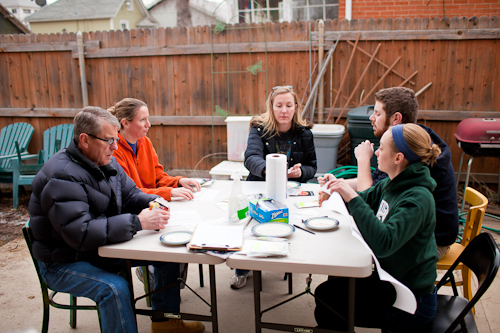




Seed starting (and some of our other seated gardening activities, like repotting) reminds me a bit of a quilting bee. A great chance to relax for a couple of hours and catch up with the folks in your community.

Henderson's Pink Ponderosa and Black Cherry tomato packets. Heirloom varieties have the best names!
Counting Purple Calabash tomato seeds.
We have a small hoophouse to grow our seedlings. It works well once seeds have germinated, but it's difficult to heat the hoophouse so that it's warm enough (consistently 70ish degrees) for seeds to sprout. So, we sprout most of our seeds indoors, in damp paper towels. Once they've germinated, then they get planted in seed trays and placed in the outdoor hoophouse.
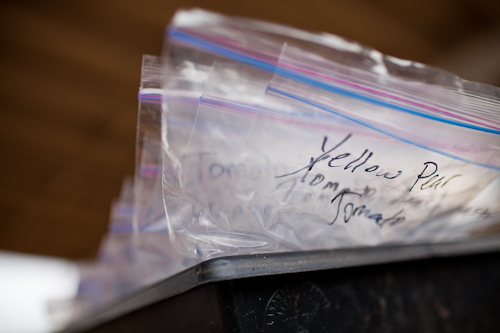
The seeds (folded into wet paper towels) then go into open plastic bags. The plastic keeps the paper towels from drying out, but leaving the bag open prevents mold.
We grow thousands of seedlings in our little hoophouse -- got to keep track of what's been planted!
Each bag typically contains 50-70 seeds. With this method, we can use just one heating pad to germinate literally thousands of seeds, rather than investing in lots of grow lights or several space heaters to heat the hoophouse.
Tuesday, February 22, 2011
Do You Care About Animals? Why Turning Backyards into Barnyards is a Great Idea!

(If you want to skip ahead to the Action Alert, scroll down and look for yellow.)
You may already know that -- after two years of growing community momentum -- Denver's City Council is getting ready to consider a new Food-Producing Animals ordinance. The ordinance is still in draft form, and Sustainable Food Denver (along with all of the members of the Sustainable Food Policy Council) have been actively soliciting feedback.
Recently, a woman who is associated with a vegan advocacy group here in Denver has started sending letters to members of her organization, other animal rights organizations, and Denver neighborhood organizations. She, as an animal rights activist, opposes the Food-Producing Animals ordinance and the general practice of keeping backyard livestock. She is strongly urging City Council to vote against the ordinance.
Now, I want to be clear -- I very much support everyone's right to their views, opinions, and dietary choices. I also understand that conflicting opinions are going to be a part of the process, especially when we're dealing with an issue as public as this one.
However, no matter how passionate someone may be about a topic, facts still matter. The author of the anti-FPA letter makes a number of claims, and they're generally based in fear-mongering and fallacy. It's worth noting that the author's sole source to back up her claims is United Poultry Concerns, a website that sells a book entitled "The Holocaust & The Henmaid's Tale: A Case for Comparing Atrocities."
I'm going to address the many myths that were present in the anti-FPA letter, and counter with facts about the keeping of backyard chickens and goats. But, before I go any further, I want to say again that I have great respect for those who choose to follow a vegan diet. In fact, there are several vegans (and vegetarians) who support the work of Sustainable Food Denver. Here is what a few of them have to say:
"Six years ago I made the decision to move from a vegetarian lifestyle to a vegan lifestyle. Not everyone is willing or able to make that sort of decision. With this understanding I am compelled to support the Food-Producing Animals ordinance. I am hopeful that families who choose to raise chickens and/or goats will halt consumption of animal products derived from factory farming processes and continue to cultivate compassion for the animals they care for. Additionally, I believe the ordinance has the potential to influence and create laws protecting farm animals from cruelty and abuse." --C.B.
"As a vegan I actually applaud and wholeheartedly support the Food Producing Animals ordinance. I feel strongly that my friends and acquaintances with chickens and/or goats care deeply about these animals and care for them as they would any other companion animal in their lives. They have chosen to take a stand and remove themselves from the vicious circle that contains animal cruelty through factory farming. It would be a shame to take wholesome and kindly produced milk and eggs from them and their children." --T.H.
"I'm a vegetarian that loves eggs, however, I haven't eaten meat for 16 years. I know that the meat eaters outnumber the vegans and vegetarians, so I choose to work with them in our society. I think the benefits of raising your own chickens are far better than the nasty conditions of the chicken warehouses. The more of us that aren't supporting the corporations slaughtering our precious animals, the better off we are at saving this planet. We can only take one step at a time and if Denver households find it easier to raise chickens, they won't go to the local grocery store to support the evil American meat business." --A.H.
If your goal as an animal rights activist is a 100% vegan society, then be honest about that and work toward it through education and outreach. However, in lieu of a purely vegan society, I can't fathom why anyone who truly cared about animal rights would prefer that consumers get their eggs and dairy from Concentrated Animal Feed Operations (CAFOs) as opposed to backyard barnyards. Not every backyard chicken-raiser is going to be perfect, to be sure -- but on average the backyard barnyard is a far cry more humane than CAFOs.
Here are some photos of the types of places where the vast majority of Americans get their eggs and dairy:


In contrast, this is where my family gets its eggs and dairy...


All right, let's get to looking at the points that the anti-FPA letter raised. Later in this post, look for the Action Alert to learn how you can help!
Myth: FPAs are bad for cities, resulting in numerous complaints and an increase in enforcement costs.
Fact: The actual experience of cities that have tried FPA ordinances is that the result is either positive or neutral for the city's agencies. A professor at DePaul University did a study of 23 cities across the country that had recently enacted chicken keeping ordinances, and the study showed very few problems, with a "positive" or "neutral" assessment of the overall impact. Cities like Seattle and Portland allow the keeping of hen chickens and dwarf goats without a permit, and Seattle even recently voted to make its laws more progressive (going from 3 hens up to 8). We can also find evidence of the lack of negative impact closer to home. Fort Collins and Longmont recently enacted chicken-keeping ordinances, and both cities had the option of "sunsetting" (cancelling) the new rules after one year. Neither city chose to invoke the sunset.
Looking at the FPA policies of other cities across the country is a fundamental part of countering each of the anti-FPA arguments. If FPAs were truly so hazardous, disruptive, etc, then cities that had tried allowing FPAs would be undoing the laws at the first opportunity. Instead, we see the opposite occurring -- every week there is a new city (large or small) that decides to allow the keeping of FPAs in some form, and cities that had previously passed FPA ordinances are often expanding them.
Myth: Urban FPAs will attract predators to Denver neighborhoods.
Fact: Small mammal predators are a fact of life in the city.
Outdoor cats, squirrels, birds, and – most especially – our garbage, all ensure
that predators will continue to stick around. In fact, with our city’s trash system, there are probably several dead chickens right now in every block of Denver
Myth: FPAs will get loose and damage neighbor's gardens.
Fact: The proposed FPA ordinance requires fencing adequate to keep the animals contained. If someone's animals get out, they're not following the ordinance. It's interesting to be concerned about the impact that chickens (who weigh about 5 pounds each) and dwarf goats (who weigh 50 pounds and can't dig) could have on a neighbor's garden, compared to the possible impact of a 100-pound dog on the loose.
Myth: Passing an FPA ordinance will increase the likelihood of on-site slaughter.
Fact: The proposed ordinance expressly prohibits the slaughtering of FPAs in a residentially zoned district. Slaughtering on-site is against the law now, and it will be against the law if the FPA ordinance passes. Yes, there will always be people who don't care about the law. But, since those people don't follow the laws anyway, they're just as likely to slaughter FPAs now as in the future.
Myth: Eggs and dairy are bad for peoples' health.
Fact: I believe that diet is a deeply personal choice. We are all different people with different body chemistries, and not everyone can thrive on the same diet. For every vegan advocacy group that states that eggs and dairy are dangerous, there are groups like the Weston A. Price Foundation that say that an exclusively vegan diet is dangerous. What can be reliably proven is that the eggs and dairy produced by healthy, ethically raised animals is safer than what comes out of CAFOs (due to antibiotics, bacterial contamination, and a host of other dangers).
Myth: Raising animals is not environmentally sustainable, because the grain used to feed them is grown on land that could be used to grow other crops.
Fact: The above isn't a misstatement, but more of a misdirection. There are a number of factors that each person considers when deciding what to eat, and land use concerns are something that motivate some folks to choose a vegan diet. However, this discussion is not about whether everyone in the world should be a vegan. (That is a separate discussion, and if 100% veganism is the anti-FPA advocate's goal, then she needs to be upfront about that.) The backyard FPA issue is about how those people who do choose to consume eggs and dairy can best obtain that food. From an environmental point of view, it goes without saying that the well-documented pollution of CAFOs is a significant environmental hazard. It is also more ecologically sound to consume food that is produced in your backyard, rather than food that has been trucked in from somewhere else.
Myth: FPAs attract mice and rats.
Fact: The recommended method for storing animal feed is in a sealable, airtight container (like a big tupperware tub). It is certainly in the FPA owner's interest to keep the food sealed so that mice aren't attracted to it. However, let's also remember that lots of people throughout the city have birdfeeders, and they can also choose to leave cat food on their front porches if they choose to.
Myth: FPA ordinances result in an increase in FPAs being turned in to animal shelters.
Fact: The DePaul University study does not support this idea of a negative impact. If an FPA owner wants to re-home their animals, there are multiple options available to them. Denver is surrounded by lots of rural space, and those "country folk" have the sense to recognize the value of an FPA -- especially if it's being given away for free. This includes roosters that occasionally show up by mistake in a chick order and older non-productive hens. It also includes baby goat offspring. There is a significant demand in the agricultural communities surrounding Denver for dwarf dairy goats.
Myth: FPAs will result in an increase in noise and odor.
Fact: First of all, FPAs are much quieter than many of the critters that are currently residing in Denver backyards. Secondly, the FPA ordinance will address the issue of disruptive animal noise. In the unlikely situation that your chickens or dwarf goats are creating a disturbance, there will be consequences. The same goes for the odor question. Poorly cared for animals of any species are likely to smell bad. However, it is not challenging to maintain FPAs in a way that does not produce an odor or nuisance to neighbors.
I want to close this section by saying that I have had the following people (among many others) visit my backyard barnyard -- seven City Councilmembers, the former mayor's chief of staff, the Zoning Administrator, the head of Neighborhood Inspection Services, the director of Animal Care and Control, and a Principal City Planner. If anyone is trained to spot problems with backyard FPAs or their impact on the neighborhood, it's these folks. Everyone inspected my little barnyard and saw that things were just fine (and I'm not even the best barnyard-keeper-upper I know!).
Action Alert: How You Can Help!
Once again, it's time to fire up those email accounts to contact our City Councilmembers and Registered Neighborhood Organizations! If you're not sure which way to point your emails:
- Click here to get the email addresses (and phone numbers) of your city councilperson. Don't forget to contact the two At-Large members!
- Click here to find out which neighborhood organization represents the area you live in, and to get the contact information.
Feel free to craft your own email from scratch. If you'd like to use a template, try this:
---
Subject: Backyard Barnyards are a Great Idea!
Dear _________,
I am writing to express my support for the proposed new Food-Producing Animals ordinance. Although the keeping of FPAs is allowed in many cities throughout the country (including Seattle, Portland, Chicago, and New York), there are still many misconceptions about raising hen chickens, ducks, and dwarf dairy goats in an urban setting. I want to share the following information with you:
- Removing the financial and bureaucratic barriers to the keeping of backyard Food-Producing Animals will have multiple benefits. It will result in improved access to healthy and affordable protein to Denver families, provide an alternative to industrially-produced food, and provide a way for our city's residents to participate in a sustainable local food system.
- Community Planning and Development, the Department of Environmental Health (including the Director of Animal Control), and the City Attorney's office all support the draft outline for a new Food-Producing Animals ordinance.
- Cities across the country have successfully adopted Food-Producing Animals ordinances, including some cities that allow these animals without a permit. DePaul University conducted a study of 23 cities across the country to investigate the impact of chicken ordinances, and found that cities rated the impact of the ordiance as either "positive" or "neutral" (link to the study at http://www.sustainablefooddenver.org). The adoption of FPA ordinances has not been shown to burden city agencies or increase enforcement costs.
- The adoption of FPA ordinances has also not been shown to increase the incidence of small mammal predators within a city. The proposed Denver ordinance requires that FPA owners have a predator-proof enclosure for their animals, and there are additional measures that owners can take to protect their animals from predators. However, every Denver resident knows that predators are a fact of life in the city. Our current garbage collection system (with dead chickens in every dumpster in Denver) ensures that our predators have a consistent food supply.
- There are multiple avenues for FPA owners to "re-home" unwanted animals. Denver is surrounded by rural areas, and many "country folks" are typically more than happy to take FPAs (they do provide food, after all).
- The proposed FPA ordinance specifically prohibits the slaughtering of animals in residential districts. Slaughtering is illegal now, and it would be illegal if the ordinance passes.
To read the draft outline for the FPA ordinance, and for additional information, go to http://www.sustainablefooddenver.org
As a resident of your (council district/neighborhood), I strongly urge you to support Food-Producing Animals in Denver!
Sincerely,
(your name)
(your address would be helpful)
You're Invited: Denver Food-Producing Animals Forum!

When: Monday, March 7th, 6:00-7:30pm
Where: The Tivoli at Auraria Campus, Room 320s
There is great impetus now in Denver to change the permitting process for having FPAs. The city has heard that the current permitting process is unclear, lengthy and expensive and that there is concern about the requirement of neighborhood notification. There is a draft outline for a new FPA ordinance that was prepared as a collaborative effort with Denver Community Planning and Development (zoning), the Department of Environmental Health (animal control), Sustainable Food Denver and the City Attorney's office.
Come join us to hear about the current process, the proposed ordinance and have a chance to ask questions and comment about FPAs in the City of Denver.
To read a DRAFT outline of the proposed ordinance, please click here.
You can RSVP for the event by contacting Dana at pompomdana@comcast.net. However, feel free to come even if you haven't RSVP'd!
Subscribe to:
Posts (Atom)

